
If you’ve noticed your organic traffic doing something strange lately — impressions holding steady while clicks quietly shrink — you’ve already felt the effect of AI search, even if nobody’s explained why. An AI Overview appearing above the normal results can cut the click-through rate for the #1 ranking page by more than half. That traffic isn’t gone. It’s just being answered before anyone reaches your site.
This guide walks you through Answer Engine Optimization (AEO) from the ground up: what it is, how AI search actually works, and a step-by-step process for getting your brand mentioned — and ideally cited — by ChatGPT, Google AI Overviews, Perplexity, and Gemini.
What Is AEO, Exactly?
Answer Engine Optimization (AEO) is the practice of making your content visible and useful to AI systems that generate direct answers instead of showing a list of links. You’ll also see it called GEO (Generative Engine Optimization) or LLMO (Large Language Model Optimization) — different names for the same discipline.
Here’s the shift in one sentence: in traditional SEO you compete for a position; in AEO you compete for a mention.
A user searching “best espresso machine under $500” on Google sees ten blue links and clicks one. The same user asking ChatGPT the identical question gets one synthesized answer that names two or three brands. There’s no list to rank in — there’s a short set of names the AI chose to include, and you either made the cut or you didn’t.
Important: AEO doesn’t replace SEO. It builds on it. Quality content, technical health, and authority are still the foundation — AEO is the layer you add on top.
Step 1: Understand Where AI Gets Its Answers
Before you optimize for anything, you need to understand the two places an AI model pulls information from:
- Training data — the static snapshot of text (websites, books, transcripts) the model learned from originally. It updates roughly every six months, so anything recent won’t be in there yet.
- Real-time retrieval (RAG) — when the AI searches the live web on the spot, pulls back relevant pages, and generates an answer from what it finds.
This matters because it gives you two separate levers: get mentioned so widely across the web that you become part of future training data, and make sure your content is well-optimized for real-time retrieval right now. The second lever is where your existing SEO skills — rankings, backlinks, quality content — directly transfer.
Step 2: Learn How Query Fan-Out Works
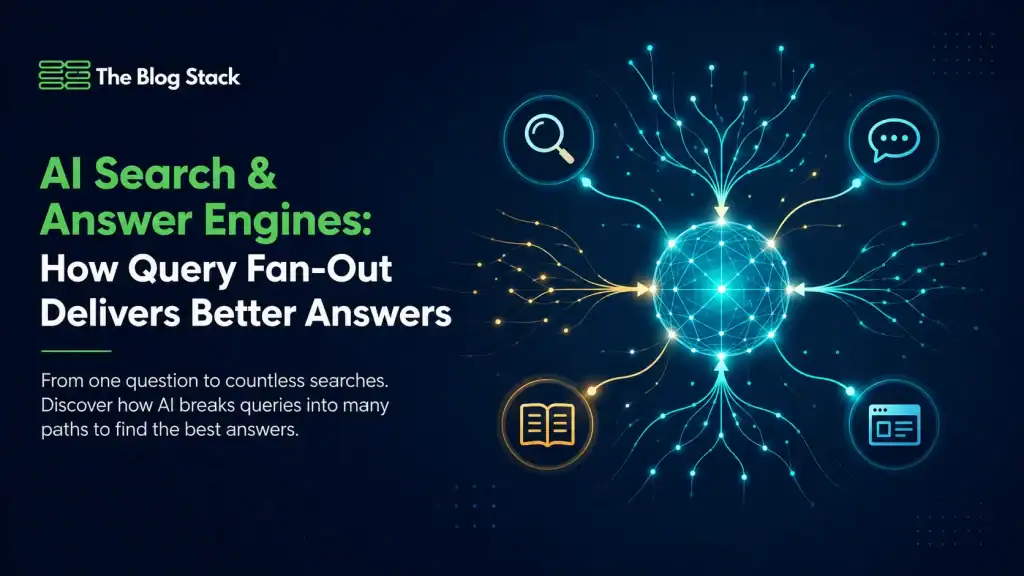
This is the single most important mechanic to understand in AEO. Traditional search is one-to-one: one query, one set of results. AI search is one-to-many: a single prompt gets expanded into dozens of smaller sub-queries running behind the scenes, a process called query fan-out.
Example: someone types “plan me a 5-day trip to Japan in November.” Behind the scenes, the AI fans that out into sub-queries like “best neighborhoods to stay in Tokyo,” “November weather in Kyoto,” and “is the Japan Rail Pass worth it” — then merges everything into one answer.
The average prompt triggers 9–11 of these fan-out queries, and some run as high as 28. Don’t try to target them individually — over 95% have zero search volume and are regenerated differently every time. Instead, use them as a signal of which sub-topics you need to cover to be seen as a complete source on the subject.
Step 3: Accept That AI Citations Are Probabilistic
In traditional search, if you rank #3 today, you’ll likely rank around there tomorrow. AI citations don’t work that way. Ask the same question five times and you might get mentioned three times, or not at all. There’s no fixed position — which is why practitioners talk about AI visibility rather than AI rankings.
Four things consistently raise your odds of being cited:
- Consensus — multiple independent sources saying the same thing about you
- Freshness — AI-cited content tends to be noticeably more recently updated
- Authority — pages that already rank well in Google have a head start
- Topic coverage — being relevant across an entire subject, not just one keyword
Step 4: Know That Every AI Platform Works Differently
This trips up almost every beginner: AI search is not one thing. Looking at the top 50 most cited domains across Google AI Overviews, ChatGPT, and Perplexity, only 7 appeared on all three platforms — just 14% overlap.
| Platform | What it favors |
| Google AI Overviews | Authoritative, established sites — health, finance, YouTube, Reddit |
| ChatGPT | Publishers and media — Wikipedia, Forbes, Business Insider, high-authority editorial |
| Perplexity | Most aligned with traditional Google rankings |
| Google AI Mode | YouTube by a wide margin, then Wikipedia and Quora |
If you’re only optimizing for one platform, you may be functionally invisible on the others. Pick your priority based on where your audience actually asks questions and where your existing strengths already overlap.
Step 5: Know the Three Types of AI Visibility
Most beginners assume AEO success means “getting a link in an AI answer.” That’s only one piece:
- Cited and linked — AI includes a clickable link to your page (the rarest outcome — only about 28% of mentions include a link at all)
- Mentioned but not linked — AI says your name with no link. No direct traffic, but real brand-awareness value; a word-of-mouth recommendation at scale
- Not visible at all — the gap you’re trying to close
Don’t discount the unlinked mentions. In a study of 75,000 brands, branded web mentions had a stronger correlation with AI visibility than backlinks, domain rating, or referring domains combined. Every time your brand name appears on a credible page connected to a topic, that’s another training example reinforcing the association — the same way “Tesla” makes you think “electric cars.”
Step 6: Run a Brand Gap Analysis
Before creating anything new, find out where you actually stand. A brand gap analysis measures the difference between where your brand should show up and where it actually does.
How to run one:
- Map your brand entities — main brand name, product names, proprietary features, and any personal brands tied to your company
- Pull your baseline SEO metrics (rankings, backlinks, traffic) alongside your AI mention and citation data
- Sort every finding into one of six gaps: visibility (competitors show up more), narrative (AI describes you inaccurately), topic (you’re missing from subjects you should own), format (competitors have video/listicle content you don’t), web mentions (you’re missing from roundups competitors appear on), and demand (searches happening in your space that never surface your name)
- Prioritize fixes into three buckets: Fix (improve something existing), Build (create something new), Influence (earn mentions through outreach)
Step 7: Do Keyword Research the AEO Way
Start the same way you always have — seed keywords plus modifiers — but add two extra filters before committing to any keyword.
The BID formula:
- Business potential — if you rank #1, does it actually help your business?
- Intent — does the current top-ranking content match the format you want to publish?
- Difficulty — do you realistically have a shot, based on who’s already ranking?
The AI filter (the new step): ask whether the AI Overview already fully satisfies the searcher for this query. If it does, there’s often no reason for anyone to click through — that keyword may not be worth targeting the traditional way. Instead, aim to get mentioned in the AI’s answer rather than clicked.
One category AI hasn’t touched yet: tool and calculator queries (“backlink checker,” “mortgage calculator”). These require the user to actually do something, which AI can’t replace — the organic click is still very much available here.
Step 8: Write Content That’s Actually Built to Get Cited
Three data points should change how you write:
- Length barely matters. The correlation between word count and getting cited is close to zero. Over half of all cited pages are under 1,000 words.
- Freshness matters a lot. Cited content is roughly 25% fresher than what typically ranks organically.
- Format matters. Nearly 44% of all cited pages are listicles — best-of lists, comparisons, and data-driven roundups.
Four writing principles make content easier for AI to lift and cite:
- BLUF (Bottom Line Up Front) — open every section with the answer, then explain it. Don’t build up to the point.
- Atomic content — every section should stand completely on its own, since AI may extract just one section and show it without the rest of the page.
- Entity-rich writing — name specific brands, products, and numbers instead of vague pronouns. “Ahrefs’ Keywords Explorer” beats “our tool.”
- Simple, declarative sentences — one idea per sentence, easy to parse for humans and machines alike.
Example — before and after applying BLUF:
Before: “Over the past few years, link-building strategies have evolved significantly due to changes in how search engines evaluate link quality.”
After: “The most effective way to build backlinks in 2026 is to create original research.” Then support the claim with context.
Step 9: Earn Mentions on Other People’s Pages
A lot of AEO isn’t about your own site at all — it’s about being mentioned on the pages AI is already pulling from. Focus on three tiers:
- Tier 1 — editorial content: industry publications, review sites, listicles on authoritative blogs. Hardest to earn, most valuable.
- Tier 2 — communities: Reddit and niche forums. Contribute genuinely useful answers to real questions — don’t drop your brand name into unrelated threads.
- Tier 3 — your own properties: YouTube, podcast, LinkedIn. Every piece adds another training example connecting your brand to your topic.
Step 10: Don’t Skip YouTube
YouTube mentions have the strongest single correlation with ChatGPT visibility of any factor studied — stronger than backlinks, domain rating, or anything else. GPT-4 alone was trained on over a million hours of YouTube transcripts.
Quick checklist for videos that actually get cited:
- Put the exact keyword in the title (save cleverness for the thumbnail)
- Write a real summary in the description, keyword in the first two lines
- Add timestamps — they become chapters that can surface for specific sub-queries
- Say the keyword out loud in the video — Google can understand audio
- Match the format that’s already ranking (tutorial vs. listicle vs. review)
Step 11: Check the Technical Basics
A surprising number of sites accidentally block AI without realizing it. Before anything else, check these:
- Robots.txt — visit yourdomain.com/robots.txt and confirm GPTBot, ClaudeBot, Google-Extended, and OAI-SearchBot aren’t disallowed. Some platforms (Cloudflare, notably) now block AI bots by default.
- JavaScript rendering — ChatGPT’s crawler can’t render JavaScript. Disable JS in your browser and reload your own site; if content disappears, so does your visibility to ChatGPT.
- Page speed — slow pages can get dropped before they’re even scored during real-time retrieval.
- Clean heading structure — AI often chunks content at heading boundaries, so a logical H1/H2/H3 hierarchy matters.
- Hallucinated URLs — AI assistants send visitors to 404 pages nearly three times more often than Google Search does. Check your analytics for AI-referred 404s and redirect them.
Step 12: Measure What’s Actually Working
AEO is harder to measure than traditional SEO, but you have three tools:
- AI referral traffic — set up a custom channel in GA4 to isolate visits from ChatGPT, Perplexity, Claude, and Gemini. Expect an undercount — several platforms strip referral data.
- AI bot activity — track which AI crawlers are visiting your site and which pages they hit repeatedly (a strong signal those pages are being used as live sources).
- Self-reported attribution — add a “How did you hear about us?” option for AI assistants to your sign-up or checkout flow. A meaningful share of AI-driven awareness never shows up in analytics at all.
Is AEO Actually Worth the Effort?
Here’s the honest picture: AI referral traffic today averages around 0.25% of total site traffic, and Google still sends roughly 210 times more traffic than the top AI platforms combined. On raw volume, it’s small.
But the visitors it does send convert dramatically better — some companies report conversion rates 10 to 20+ times higher than standard organic traffic, because when AI recommends a brand, it has already explained to the user why it’s a good fit. The traffic arrives pre-sold, not browsing.
And beyond direct traffic, every AI mention is a brand impression you didn’t have before — most never result in a click, but they shape whether someone Googles your name later or recognizes you elsewhere. It’s closer to brand marketing than performance marketing: harder to attribute precisely, but still real.
Your First-Week AEO Checklist
- [ ] Check your robots.txt for AI bot blocks (5 minutes, the most common accidental blocker)
- [ ] Set up an AI traffic channel in your analytics tool
- [ ] Add a “how did you hear about us” question to your sign-up or checkout flow
- [ ] Refresh your 5–10 most important pages with genuinely new information, not just a new date
- [ ] Run a brand gap analysis to find out where you actually stand today
- [ ] Shortlist 10 pages where earning a mention would meaningfully move your AI visibility
The Bottom Line
AEO is still early. The platforms are evolving, the data is improving, and most businesses haven’t started thinking about this seriously yet. That’s exactly the advantage: the brands building this layer now, while it’s still uncrowded, are the ones AI will already be citing confidently by the time everyone else catches up.
Start with the robots.txt check today. It takes five minutes and it’s the single most common reason good content never reaches AI in the first place.
